Stake.us
The most conservative US footprint: 22 states named as excluded in its own terms.
External site. Check the state list there before signing up.
Terms audited
Sweepstakes Ltd.21+Not licensed gambling28 states not excluded22 excluded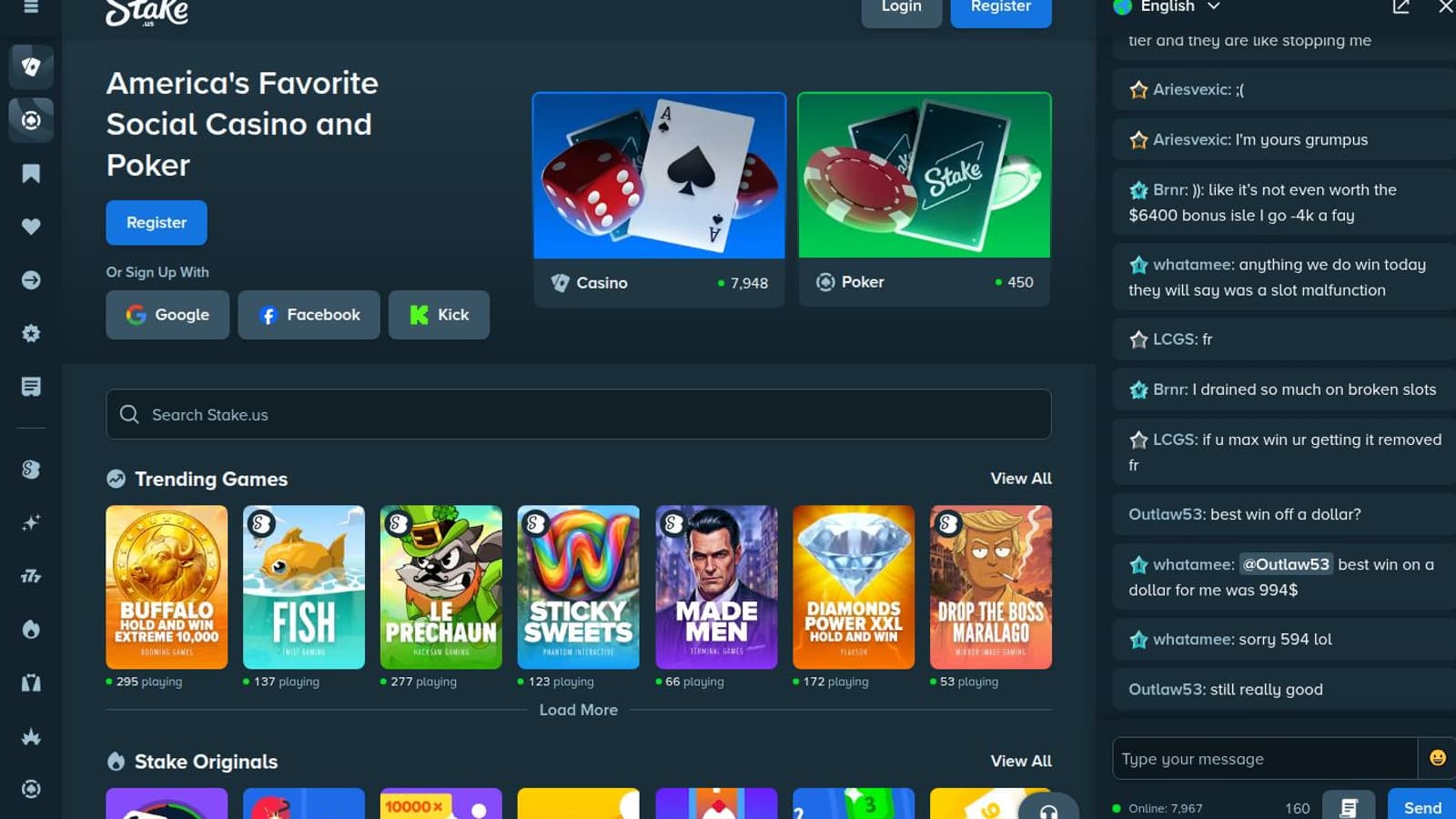
Stake.us at a glance
Stake.us was audited from the operator's own terms. The welcome offer line comes from the source linked here, not from the terms.
CryptoSlate: Stake.us review (29 Oct 2026)- Welcome offer
- Daily 1 sweeps coin plus welcome promotions, no purchase necessary
- Smallest cash prize
- Only Stake Cash is redeemable; Gold Coins have no prize value.
- States excluded
- 22 of 51
- Minimum age
- 21+
- Terms version
- Terms v18, 2026-07-10
- Offer conditions
- Crypto or bank redemption; one request per 24 hours
Documented advantages
- Only Stake Cash is redeemable; Gold Coins have no prize value.
- Bonus Stake Cash can carry a 3× play-through before it is redeemable.
- A fiat or crypto redemption rail is blocked while a Stake Cash balance remains.
Gold coins are play money with no cash value; only the sweeps-style coin is redeemable, at the rate this brand states (most are 1 SC = $1, Fortune Coins and Funrize use 100 = $1).
| Term | What we recorded |
|---|---|
| Excluded states | 22 of 51 |
| Operated by | Sweepstakes Ltd. |
| Model | Dual currency (Gold Coins + Stake Cash) |
| Minimum age | 21+ |
| Terms version | Terms v18 |
| Terms date | 2026-07-10 |
| Audit depth | Full terms audit |
Excluded states
Named in the operator’s own terms. Enforced at sign-up.
- WA
- NY
- NV
- ID
- KY
- MI
- VT
- NJ
- DE
- WV
- PA
- RI
- CT
- MD
- LA
- MT
- AZ
- TN
- CA
- IL
- IN
- ME
Closed by state law
Not named in Stake.us's operator list, but the state has closed the market. The statute decides, so these are not options even though the list does not exclude them.
- OK
Open states
Not excluded, subject to change without notice.
- AL
- AK
- AR
- CO
- DC
- FL
- GA
- HI
- IA
- KS
- MA
- MN
- MS
- MO
- NE
- NH
- NM
- NC
- ND
- OH
- OR
- SC
- SD
- TX
- UT
- VA
- WI
- WY
Money in, money out
Stake.us separates a purchase rail from a prize rail. Wallet payments almost never pay a prize.
This brand's floor, next to every other- Deposits
- Visa
- Mastercard
- Bitcoin
- Ethereum
- XRP
- Tether
- Prize redemption
- Crypto or bank transfer, with one request per 24 hours
The only brand in this set that leads with crypto on both sides; the terms block a fiat rail while a Stake Cash balance remains.
What the reviews report
Third-party reviews of Stake.us, not the operator's own document. Where they disagree with the audit above, the audit wins. Sources read on 2 November 2026.
Sources
- Sign-up offer
- 250,000 Gold Coins (no cash value) + 25 free SC at sign-up, plus 1 SC (≈ $1) and 10,000 GC (no cash value) daily
- Deposit methods
- Bitcoin
- Ethereum
- Litecoin
- Dogecoin
- USDT
- Prize redemption
- Stake Cash redeemed for crypto (BTC, ETH or USDT), gift cards or merchandise; ID verification needed; crypto hours to days
- Minimum prize
- 75 SC (≈ $75) minimum cash-out
- Processing time
- Listed as instant, with crypto taking a few hours to a few days after verification
- Play-through
- 3x wagering on bonus and purchased Stake Cash
- Games
- Between 550+ and 3,000+ depending on the source; 2,226 slots in one count
- Studios
- Pragmatic Play, Hacksaw, BGaming, Evolution, Octoplay, 3 Oaks, 7Rings
Practical points
- The welcome needs no purchase, but bonus and purchased Stake Cash both carry a 3x playthrough.
- Only crypto is supported, so set up a wallet before buying coins or cashing out.
- The $20 minimum purchase is the highest entry point in this set.
What the product looks like
Screenshots of the Stake.us interface, without balances or account details.


How the model works
Dual currency (Gold Coins + Stake Cash). Gold Coins are bought and have no prize value; the sweepstakes currency is granted free and is the only balance that can be redeemed.
That structure is why Stake.us can operate without a gaming licence, and why a redemption is a contractual request rather than a regulated payout.
For Stake.us's four numbers under Terms v18 (2026-07-10), see how to read a terms page. For the verification step, see redemption and KYC.
Redemption rules
- Only Stake Cash is redeemable; Gold Coins have no prize value.
- Bonus Stake Cash can carry a 3× play-through before it is redeemable.
- A fiat or crypto redemption rail is blocked while a Stake Cash balance remains.
- One redemption request per 24 hours, with a daily cap in some states.
- 21+ and identity verification are required before the first redemption.
Rules summarised from the operator’s published terms (Terms v18, 2026-07-10). Terms change; verify before requesting a redemption.
What to check before you play
- Your state is not on the excluded list, and you are physically there when you play.
- The minimum redemption and the processing window in the current terms.
- Whether bonus sweepstakes currency carries play-through conditions.
- That your ID and payment details match your account name.
Who is behind Stake.us
Stake.us is the US-facing sweepstakes arm of the Stake brand, operated by Sweepstakes Ltd. It is not the same legal entity as Stake.com, the offshore real-money casino, and the two should not be confused: a problem with one is not resolved by the other, and the US product is governed by its own terms, its own support team and its own state restrictions.
The brand arrived in the US market with an advantage most sweepstakes operators did not have: an existing audience, a recognisable interface and a library of in-house games. That is also why its state footprint is the most conservative in the category. A brand with a large existing audience has more to lose from a state attorney general than a small operator chasing volume, so it exits earlier and blocks more aggressively.
For you, that trade-off is the central one. Stake.us is likely to be available in fewer states than a challenger brand, but the states where it operates are less likely to be the subject of an abrupt enforcement action. Neither outcome is guaranteed; the point is that the brand's risk appetite is part of the product.
The Stake Cash economy
Stake.us runs on Gold Coins and Stake Cash. Gold Coins are the purchasable currency: they have no prize value, they cannot be redeemed, and they exist to fund the promotional side of the model. Stake Cash is the sweepstakes currency: it is granted free, it is what you play with when you want a chance at a prize, and it is the only balance that can be redeemed.
The important detail is that not every Stake Cash balance behaves the same way. Cash granted as part of a purchase promotion can carry play-through conditions, while cash from a daily login or a mail-in request may not. The terms classify balances, and the classification decides whether a redemption request is accepted. This is why two players with identical balances can have different outcomes.
Stake.us also advertises a rakeback-style benefit and periodic promotions. Treat any percentage you see on a landing page as marketing until you find the clause that defines how it is calculated and whether the resulting balance is redeemable. A rakeback figure that produces non-redeemable currency is not value; it is engagement.
| Source | What it gives you | What to check |
|---|---|---|
| Purchase promotion | Gold Coins plus a free Stake Cash grant | Play-through and whether the grant is redeemable |
| Daily login bonus | Small recurring grant | Expiry and any account-status conditions |
| Mail-in AMOE | Free entry without purchase | Exact instructions, postage and processing time |
| Event or stream promo | Time-limited grant or code | Eligibility by state and account age |
| Rakeback-style benefit | Recurring percentage of play | Whether the result is Gold Coins or Stake Cash |
Why 22 states are excluded
The excluded list is not random. It maps onto three legal situations, and understanding which one applies to your state tells you how likely the situation is to change.
The first group is states with an explicit ban: California, New York and New Jersey passed legislation in 2025, and Indiana, Maine, Tennessee, Louisiana and Oklahoma followed in 2026. In these states the question is settled at the statute level, and no operator policy can make the product available.
The second group is states where the operator faces enforcement risk without a specific statute: Illinois and Kentucky are the clearest examples, with cease-and-desist letters and litigation respectively. Operators exit these states defensively, because the cost of a legal fight exceeds the revenue.
The third group is states where gambling law is broad enough that counsel advises against the model: Washington, Michigan, Nevada, Montana, Idaho and others. These exclusions can persist for years because they are based on legal interpretation rather than a new bill.
Stake.us excludes states from all three groups, which is why its list is longer than the list of explicit bans. A state being absent from the statute books does not mean a brand will accept you there.
What the open states mean in practice
Being in an open state is necessary, not sufficient. Stake.us verifies location when you sign up and can re-check it at redemption. The relevant fact is where you physically are when you play, not where your billing address is or where you were when you created the account.
If you travel, the rule follows you. Playing from an excluded state (even briefly, even on a phone) is a terms breach, and it is one of the standard reasons a redemption is voided. The same applies to a VPN, which the operator can detect and which is explicitly prohibited.
There is also a practical asymmetry worth knowing. The operator can change its state list at any time, and it does not need to give notice for a state to be added. A brand that accepts you today can stop accepting you next month. That is why the rational approach is to keep balances small and redeem earlier than feels necessary, regardless of how stable the brand appears.
Redemption: the full sequence
Redemption at Stake.us is a multi-step process, and each step has a failure mode. The sequence below is the one described in the terms and observed by players; treat the timing as indicative, not guaranteed.
First, conversion. Only Stake Cash is redeemable, and the request must meet the minimum. If your balance includes non-redeemable grants, you may need to play through them before the redeemable portion is released.
Second, eligibility. The operator checks your state, your account status and whether any promotion is still active. A pending bonus can block a request even when the balance looks available.
Third, verification. Identity, address and payment-method ownership are checked. The name on the account, the ID and the destination account must match. This is the most common source of delay and the easiest to pre-empt.
Fourth, the pending window. Stake.us applies a holding period during which the request can be reviewed or cancelled. The terms describe one request per 24 hours, so a second request in the same day is not a queue-jump; it is a separate day.
Fifth, payment. The rail that is available depends on your state and your verification. A cap can apply to the amount paid in a single day, and the operator can block a fiat or crypto rail while a Stake Cash balance remains.
The practical lesson is to test the whole sequence with a small amount. A $20 redemption that completes tells you more about the operator than a $2,000 request that stalls.
| Stage | What happens | Typical failure |
|---|---|---|
| Conversion | Stake Cash becomes a redeemable request | Bonus grant not yet played through |
| Eligibility | State, account and promotion checks | State changed or promotion still active |
| Verification | ID, address and payment ownership | Name mismatch or expired document |
| Pending | Holding period before processing | Request cancelled or resubmitted |
| Payment | Rail releases the funds | Daily cap or rail unavailable in the state |
Verification and the documents that matter
Stake.us asks for government-issued photo ID and proof of address, and it may ask for a liveness check. The documents must show the same name as the account. A middle name, a maiden name or an abbreviated first name can trigger a manual review that adds days.
The address document should be recent, typically within the last 60 to 90 days, and should show the address you entered at sign-up. A bank statement with a different address is worse than no document at all, because it creates a discrepancy the reviewer has to resolve.
Payment ownership is the third leg. If you deposit by card, the card must be in your name; if you use a bank transfer, the account must match. Third-party payments are a standard red flag and a common reason for a frozen withdrawal.
Do this before you win, not after. A verified account is the single cheapest insurance available in this category, and it costs fifteen minutes.
- Use the exact name that appears on your ID when you register.
- Upload a utility bill or bank statement dated within 90 days.
- Make sure the payment method is in your own name.
- Keep a dated copy of everything you submit.
- Ask support to confirm verification is complete, in writing.
Bonuses, play-through and the 3x rule
Stake.us applies play-through to promotional Stake Cash. The commonly cited requirement is 3× on bonus-derived cash, meaning you must wager three times the granted amount before it becomes redeemable. The exact figure depends on the promotion, so check the specific terms rather than the general page.
Play-through interacts with game contribution. Slots usually count fully, table games often count partially, and some games are excluded. A player who clears a bonus on blackjack may find it takes far longer than the headline multiplier suggests.
There is also a maximum redemption consideration. A large grant with a low cap is worth less than a smaller grant with no cap, because the cap, not the grant, decides the ceiling. This is the most common way a headline offer disappoints.
The rational approach is to value an offer by expected redeemable value, not by the number in the banner: grant × probability of clearing × (1 − house edge over the play-through) − any cap effect. Most players do not need the formula; they need the rule of thumb that a big number with conditions is usually worth less than a small number without them.
Games, providers and what actually differs
Stake.us offers in-house originals, crash-style and instant games, alongside third-party slots and table games. The catalogue is one of the brand's genuine advantages: the originals are distinctive, and the slot selection is broader than many sweepstakes competitors.
For a player comparing brands, the relevant question is not the number of games but the shape of the library. A brand with 600 slots and no live dealers is a different product from one with 200 slots and live blackjack. Stake.us leans toward instant and slot content rather than live-dealer depth, so if live tables are the reason you play, test the section before you buy.
Game fairness is the other question. Sweepstakes operators are not required to publish RTP data the way licensed operators are, and independent testing is not universal. Where a provider is named, the game is usually the same certified build used elsewhere; where the game is in-house, there is less external assurance. That is a real difference, and it should inform how much you stake on originals versus third-party titles.
Mobile, performance and account security
Stake.us runs in the browser and is usable on mobile without a native app. That is convenient and also a security consideration: there is no app-store review layer, so the only protection is the site's own authentication.
Enable two-factor authentication if it is offered, use a unique password, and avoid logging in on shared devices. A compromised account in this category is expensive because redemption requires identity verification, an attacker who changes your details can lock you out of your own balance.
Performance is generally good on modern connections, but instant games are sensitive to latency. If you play crash-style titles, a stable connection matters more than on slots, because a dropped session during a round is a support ticket, not a redo.
Support and escalation
Support is the only dispute channel that exists before consumer protection becomes relevant. Stake.us offers chat and email; response quality varies by shift, and the first reply is often a template.
The way to get a useful answer is to ask a specific question with a date attached: which verification step is outstanding, what the current pending period is under the terms, and what the maximum single redemption is. Vague questions get vague answers, and a vague answer is not evidence.
If a redemption is refused, ask for the clause that applies. If the answer cites a term you can read, you have a decision to make; if it cites nothing, you have a record. Keep every transcript. In a market without a regulator, documentation is the only leverage a player has.
What Stake.us does better than most
It is transparent about its state restrictions. The excluded list is published, specific and enforced, which is more than many competitors offer. A brand that tells you where it cannot operate is easier to evaluate than one that lets you sign up and fails you at redemption. That transparency is worth something even when the list is inconvenient.
Its terms are comparatively explicit about the mechanics that matter: the play-through on bonus cash, the one-request-per-day rule, the rail restriction while a balance remains. These are not player-friendly clauses, but they are legible, and legibility is the first requirement of fair dealing.
The product itself is strong. The originals are distinctive, the slot library is broad, and the interface is one of the better ones in the category. If your state is open, the experience is closer to a licensed casino than to the average sweepstakes site.
Where it falls short
The footprint is the obvious limitation: 22 excluded states means a large share of US players cannot use it at all, including the three largest markets. That is a deliberate trade-off, but it is still a limitation.
Redemption is slower and more conditional than the marketing implies. The one-request-per-day rule and the rail restrictions create friction that a licensed casino would not impose, and there is no regulator to appeal to when the friction becomes a refusal.
The rakeback and promotional language is more prominent than the conditions behind it. That is standard for the category, and it is still a reason to read the bonus terms before you treat a percentage as value. A percentage that produces non-redeemable currency, or that expires before you can use it, is a retention device rather than a benefit, and the terms, not the banner, decide which one it is.
How it compares with other sweepstakes brands
Against Chumba and LuckyLand, Stake.us is less available but more explicit. VGW's brands have a longer history and a larger footprint in some states, but their terms are less forthcoming about the mechanics that decide a redemption.
Against McLuck and the wider B-Two group, Stake.us is more conservative on states and stronger on original games. McLuck is available in more states, which matters if yours is excluded by Stake, but its redemption documentation is thinner.
Against challenger brands such as Crown Coins and RealPrize, the difference is usually attribution and speed rather than product. Challengers compete on faster redemption and lower entry points; Stake competes on brand and catalogue. Neither advantage is permanent.
| Brand | State footprint | Strength | Weakness |
|---|---|---|---|
| Stake.us | 28 states open, 22 excluded | Originals, explicit terms, catalogue | Narrow footprint, slow redemption |
| McLuck | 17 states excluded | Broader availability, simple product | Thinner redemption documentation |
| Chumba / LuckyLand | Large but contracting | History, brand recognition | Less explicit terms |
| Challengers | Varies | Speed, lower entry | Less track record |
A worked example: what $50 actually buys
Suppose you buy a $50 Gold Coin bundle that includes a free grant of 50 Stake Cash, with 3× play-through on the grant. The headline is $50 of sweepstakes currency. The reality is that you must wager 150 Stake Cash before the grant becomes redeemable, and your return on that wagering depends on the games you choose.
On a slot with a 96% RTP, the expected cost of clearing 150 in play-through is roughly 6 in value, about $6, before any outcome variance. On a table game with a lower house edge but partial contribution, the same clearance can take longer and cost less per unit, which is why contribution rules matter more than the multiplier alone.
Now add a redemption cap. If the promotion caps redemption at 100, the difference between a 50 grant and a 500 grant collapses: both are worth at most the cap. This is why the number that matters is not the grant size but the smallest of grant, cap and expected clearing value.
None of this makes the offer bad. It makes it an entertainment purchase with a calculable expected cost, which is the correct way to think about any casino-style product. The mistake is treating the banner number as money.
| Offer | Grant | Play-through | Cap | Practical ceiling |
|---|---|---|---|---|
| A | 50 SC | 3× | None stated | Grant value, minus clearing cost |
| B | 500 SC | 10× | 100 | Capped at 100, the grant is marketing |
| C | 20 SC | 1× | None stated | Small but cheap to clear |
Common account problems and how to avoid them
Most account problems at Stake.us are self-inflicted, and almost all of them are avoidable with ten minutes of care at sign-up.
The first is the name mismatch. Registering with a nickname, a shortened first name, or a partner's surname creates a discrepancy that verification cannot resolve without a manual review. Use the exact legal name on your ID, even if you never use it socially.
The second is the shared household. Two players at the same address, on the same device, with the same payment method look like a linked-account case. If you live with another player, tell support before you both verify, and expect a review. It is better to resolve it before a redemption than after.
The third is the bonus stack. Claiming multiple promotions without reading their interaction rules can leave a balance that is partly locked, partly expired and partly non-redeemable. The balance display may show a single number; the terms see several.
The fourth is the abandoned request. A pending redemption that is cancelled and resubmitted can reset the clock. If a request is pending, ask support for the expected completion date in writing rather than starting again.
- Register with the exact name on your government ID.
- Tell support about a shared household before verification.
- Claim one promotion at a time until you understand the interaction rules.
- Do not cancel and resubmit a pending redemption without asking first.
- Keep a dated log of every request and every reply.
Payment methods and timing
Stake.us supports a limited set of rails compared with a licensed casino, and the available method depends on your state and your verification status. The usual pattern is card or bank transfer for purchases and a narrower set for redemptions.
Timing has three layers. The pending period is internal and typically measured in hours to a few days. The processing step is where the operator releases funds to the rail. The rail itself (bank, card network or crypto) adds its own settlement time. A published window usually describes the middle layer and quietly excludes the other two.
Fees are another layer. The operator may not charge a fee, but the receiving bank can, and crypto rails can cost more in network fees than the amount justifies for small redemptions. Check the total cost before choosing a method, not after.
The practical rule is to use the same rail for purchase and redemption where possible. Matching reduces verification friction and avoids the third-party-payment flag that freezes withdrawals.
Safety, scams and account takeover
The category attracts scams because the product is virtual currency and the audience expects free grants. Three patterns recur.
Fake code generators promise free Stake Cash in exchange for a login, a survey or a small payment. There is no such thing. A generator that asks for your credentials is an account-takeover attempt; one that asks for money is fraud.
Cloned sites copy the interface and the branding but not the domain. Check the address bar, not the logo, and never enter credentials from a link in a message. Bookmark the site you verified.
Finally, account takeover. Because redemption requires identity documents, an attacker who changes your email and password can lock you out of your own balance and, in the worst case, use your documents. Two-factor authentication, a unique password and a check of active sessions are the minimum.
Stake.us versus a licensed casino: what changes for your money
The games can be identical. The protections are not. At a licensed operator, a withdrawal dispute goes to a state regulator with the power to examine records and order payment. At Stake.us, a dispute goes to support, then to consumer protection, and the timeline is measured in weeks rather than days.
Licensed casinos must publish approved rules, submit to testing and maintain segregated player funds in most jurisdictions. Sweepstakes operators are not subject to those requirements. Some do them voluntarily; none are legally compelled to.
Tax treatment is broadly similar, prizes and winnings can be taxable either way, but reporting is less standardised in the sweepstakes model, which puts more of the record-keeping burden on you.
What you gain in exchange is access: in most states there is no licensed online casino, so the choice is a sweepstakes product or nothing. That is a real trade, not a marketing one, and it should be priced accordingly: smaller balances, earlier redemptions and a lower tolerance for poor support.
| Question | Stake.us | Licensed casino |
|---|---|---|
| Who can force a payout | No regulator | State gaming commission |
| Rules approval | Operator's own | Regulator-approved |
| Fund segregation | Not required | Required in most states |
| Dispute timeline | Weeks, uncertain | Defined complaint process |
| Access | 28 states | 7 online casino states |
If a redemption is refused
A refusal is not always final. The first step is to ask which clause applies, in writing, and to keep the reply. Most refusals cite verification, bonus conditions or state eligibility, and each has a different remedy.
If it is verification, resubmit clean documents that match the account exactly. If it is a bonus condition, ask for the specific play-through calculation and check it against your game history. If it is state eligibility, stop: there is no remedy that does not involve breaching the terms.
If support will not explain the refusal, escalate in writing to the operator's published complaints address and state the facts with dates. In parallel, a consumer protection complaint to your state attorney general is the only external lever available; it will not produce a fast payment, but it creates a record.
What not to do: open a second account, use a VPN, or keep playing to unlock a blocked balance. Each of those converts a resolvable dispute into a terms breach.
A fifteen-minute terms review you can actually do
You do not need to read the whole agreement. Fifteen minutes on the right five sections will tell you more than an hour of skimming.
Start with eligibility and confirm your state is permitted, not merely absent from a ban list. Then find the section on purchases and free grants and note which balance is redeemable. Then the bonus section: play-through, game contribution, cap and expiry. Then redemption: minimum, method, window and verification. Finally, the section on account closure and state exit.
Write four lines in a note: my state is permitted; my redeemable balance is X; my play-through is Y; my redemption window is Z. If any of the four is unclear after fifteen minutes, that is your answer, the terms are not written for you to understand, and support should be asked before any purchase.
This sounds laborious. It is also the entire difference between a player who can predict a redemption and one who writes a complaint after the fact. Keep the four lines somewhere you will see them again before your next request.
- Eligibility: is my state listed as permitted?
- Currency: which balance can be redeemed?
- Bonus: what play-through and cap apply?
- Redemption: minimum, method and window?
- Exit: what happens if the operator leaves my state?
Our test protocol for this page
We read the terms and recorded the version and date. We checked the excluded states against the published list and cross-referenced them with the 2026 bans. We reviewed the redemption clauses and the play-through conditions.
We have not published a payout time for Stake.us because our own sample is not yet large enough to support one. When it is, the number will appear here with the date, the method and the amount, not as a marketing claim.
If you see something on this page that no longer matches the operator's terms, tell us. Corrections are published with a date, and the page history is the record.
One more limitation worth stating plainly: we describe terms, not fairness. A clause can be legally clear and still produce an outcome players consider unfair. Where that tension exists, we say so rather than resolving it in the operator's favour.
Reviewed by Darnell Simons
Darnell Simons tested casinos and sportsbooks as a player long before he wrote about them, and now covers sweepstakes and social casinos the same way: open an account, read the terms, test a small redemption, and write down what actually happened.
Stake.us: common questions
Is Stake.us available in my state?
Check the excluded list above. Stake.us's terms exclude 22 states, and those exclusions are enforced at sign-up. If your state is on the list, the operator will not accept you; using a VPN to bypass it breaches the terms and can void a redemption.
How does Stake.us redemption work?
Only Stake Cash is redeemable; Gold Coins have no prize value. Bonus Stake Cash can carry a 3× play-through before it is redeemable. A fiat or crypto redemption rail is blocked while a Stake Cash balance remains. One redemption request per 24 hours, with a daily cap in some states. 21+ and identity verification are required before the first redemption.
Is Stake.us a licensed casino?
No. Stake.us operates as a sweepstakes promotion with virtual currencies and a free entry route. It is not a licensed gambling operator, and no state gaming regulator stands behind a redemption.
Can I play Stake.us for free?
At Stake.us, yes. The free route sits in Terms v18 (2026-07-10): it requires an alternative method of entry, usually a free postal request, so no purchase is necessary. Purchases buy Gold Coins, which have no prize value.
Does Stake.us have a licence?
No. It operates as a sweepstakes promotion, not a licensed casino. There is no state gaming regulator supervising its payouts, which is why redemption is a contractual matter.
Can I have more than one Stake.us account?
No. Multiple accounts are prohibited and are one of the standard reasons a redemption is voided. Linked accounts (same device, address or payment method) can also trigger a review.
Why is my Stake Cash not redeemable?
Usually because it came from a promotional grant that still carries play-through, or because it is a bonus balance excluded from redemption. Check the specific promotion's terms rather than the general balance display.
Does Stake.us report winnings to the IRS?
Operators may issue a reporting form above a threshold, but the absence of a form does not make a prize non-taxable. Keep your own records and check the current rules; this is not tax advice.
Can I play Stake.us from a state it excludes if I use a VPN?
No. Geolocation is part of the operator's compliance, VPN use breaches the terms, and redemption requires a location check. A voided balance is the likely outcome.
Is Stake.us the same as Stake.com?
No. Stake.com is an offshore real-money casino; Stake.us is the US sweepstakes product operated by Sweepstakes Ltd. They share a brand and an interface, not a licence or a legal structure.
Back to state availability and redemption and KYC.